PR After Study in Canada: The Honest Route, Stage by Stage
PR After Study in Canada: The Honest Route, Stage by Stage
PR after study in Canada is a five stage route: a qualifying programme, the study itself, a post graduation work permit applied for within 180 days, one year of skilled Canadian work, and then a permanent residence application. Nothing in that chain is automatic, and the first stage decides whether the rest is available at all.
Canada Shaws Consulting Inc. · Richmond, BC · Practising since 2015 · Regulated by the College of Immigration and Citizenship Consultants (CICC)
This guide is free to read and nothing here asks you to contact anyone. If you want the route mapped against your own situation before you enrol, the assessment is free.
On this page
- PR after study in Canada: what the route actually is
- Stage 1: Choose a programme that produces a work permit
- Stage 2: Study, and build the record you will need later
- Stage 3: Apply for the work permit within 180 days of finishing
- Stage 4: Earn one year of skilled Canadian work experience
- Stage 5: Enter Express Entry, or take a provincial route
- How long the whole route takes
- Where the route breaks
- Frequently asked questions
PR after study in Canada: what the route actually is
Studying in Canada does not lead to permanent residence directly. What it produces is a work permit, and what the work permit produces is Canadian work experience, which is what the immigration programmes actually select on. The Canadian Experience Class asks for one year of skilled Canadian work and sets no education requirement at all.
| Stage | What it produces | What can stop it |
|---|---|---|
| 1. Choose the programme | A study permit application that can lead somewhere | A programme with no work permit at the end |
| 2. Study | A credential, and a clean compliance record | Breaching the 24 hour work limit, or a status gap |
| 3. Work permit | Up to three years of open work authorisation | Missing the 180 day deadline, or the language test |
| 4. Work | One year of skilled Canadian experience | Working in a job classified below TEER 3 |
| 5. Permanent residence | An application through Express Entry or a province | Ranking below the cut off in every round you are in |
The Canadian education itself is worth something, but less than most applicants assume. Under the Comprehensive Ranking System a Canadian post secondary credential of one or two years adds 15 additional points, and three years or more adds 30. Canadian work experience is worth up to 80. A provincial nomination is worth 600.
If you are still weighing up whether to come at all, why study in Canada sets out what the study permit is worth on its own terms. For how the permit itself is decided, read the Canada study permit guide.
Stage 1: Choose a programme that produces a work permit
Stage 1 decides whether stages 3, 4 and 5 exist. For study permit applications made on or after 1 November 2024, a college or short university credential only leads to a post graduation work permit if the field of study is on IRCC’s eligible list. Bachelor’s, master’s and doctoral graduates are exempt from that test.
The eligible list runs to more than 900 programmes in health care, science and technology, trades, transport, and agriculture and food. It is revised, so check it against the specific programme code on your offer rather than against the general subject area.
Length matters as well. Two years or more supports a three year work permit, which is the length that comfortably covers the one year of work the Canadian Experience Class needs plus the time to prepare and file. A shorter programme gives a shorter permit, and a permit close to twelve months leaves almost no margin.
Programmes delivered by a private college under licence from a public one are outside the work permit entirely if you started after 15 May 2024, and outside it in every case where the licence comes from a public institution in another province. How to choose a university in Canada sets out the checks in order.
Sources: IRCC, Post graduation work permit: Who can apply and Graduates of curriculum licensing programs, checked 10 September 2026.
Stage 2: Study, and build the record you will need later
During the programme, two things decide whether stage 3 is available: staying enrolled full time at the institution named on the permit, and respecting the 24 hour weekly limit on off campus work during academic sessions. Breaching either is a breach of the permit conditions, with consequences that reach every later application.
IRCC’s published consequences for exceeding the work limit are losing student status, refusal of future study or work permits, and having to leave Canada. There is no version of this where the extra hours were worth it. The same kind of rule, with a deadline that is easy to miss, applies to school transfers, expired permits and the post graduation work permit, and our tips for international students in Canada set them out side by side.
Two practical points that matter later and cost nothing now. Keep every pay stub and record of employment, because the Canadian Experience Class is proved with employment records and not with recollection. And check the National Occupational Classification code of any job you take, because TEER 4 and TEER 5 work does not count toward that programme however long you do it.
If your partner is with you, their open work permit depends on your level of study: a master’s of 16 months or longer, a doctorate, or one of IRCC’s listed professional degrees. Their Canadian work experience counts toward their own eligibility as a principal applicant, which is worth knowing before you decide whose application leads.
Source: IRCC, Work off campus as an international student, checked 10 September 2026.
Stage 3: Apply for the work permit within 180 days of finishing
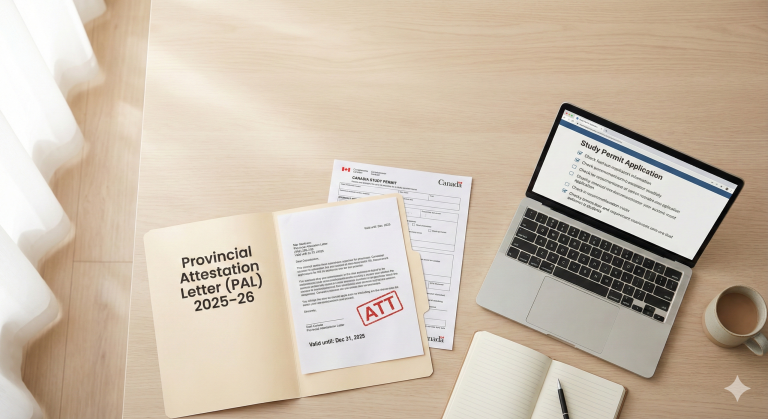
A post graduation work permit application has to be submitted within 180 days of the confirmation that you completed your programme. Applicants who applied for a study permit on or after 1 November 2024 also have to prove language ability: Canadian Language Benchmark 7 in all four abilities for university graduates, and CLB 5 in all four for college and other non university graduates.
Book the language test before the transcript arrives rather than after. Test dates and result turnaround eat into the 180 days, and a marginal score means booking again. Graduating in English does not substitute for a result, whatever the programme was taught in.
The permit length follows the programme: eight months to two years gives roughly the length of the programme, and two years or more gives three years. Since 15 February 2024 a master’s graduate can receive three years even where the master’s itself was shorter, and the exception does not apply to certificates or diplomas.
One limit catches people every year. IRCC issues the work permit only for the period your passport is valid, so a passport with eighteen months left turns a three year entitlement into an eighteen month document. Renew the passport before you file. The post graduation work permit guide goes through the documents.
Sources: IRCC, Who can apply and About the PGWP, checked 10 September 2026.
Stage 4: Earn one year of skilled Canadian work experience
The Canadian Experience Class requires at least one year of paid work in Canada, or 1,560 hours counted at 30 hours a week, gained within the three years before you apply, in an occupation classified TEER 0, 1, 2 or 3. Volunteer work and unpaid internships do not count, and there is no education requirement.
Part time hours accumulate toward the 1,560, which matters for graduates who start on contract or on shift work. What does not accumulate is time in a TEER 4 or TEER 5 job, and that is the single most common way a graduate reaches the end of a three year work permit without qualifying.
Check the classification of the job at the offer stage, not at the application stage. The occupation is judged on the duties actually performed, so a job title alone settles nothing, and a reference letter written after the fact cannot add duties that were never part of the role.
Canadian Experience Class applicants have to intend to live outside Quebec. Experience gained while living in Quebec still counts if you can show you do not intend to settle there, and Quebec runs its own selection system for people who do. Graduates who finished an eligible Quebec diploma by 19 November 2025 can look at PEQ Quebec, reopened temporarily in 2026.
Source: IRCC, Canadian Experience Class, checked 10 September 2026.
Stage 5: Enter Express Entry, or take a provincial route
With one qualifying year of Canadian work you can enter the Express Entry pool and be ranked under the Comprehensive Ranking System. Canadian work experience is worth up to 80 points, a Canadian post secondary credential adds 15 or 30, and a provincial nomination adds 600, which in practice decides the outcome on its own.
In February 2026 IRCC said this year’s invitations would centre on candidates with Canadian work experience, alongside category rounds aimed at labour shortages, top talent, and French speaking immigration outside Quebec. New categories for 2026 include foreign medical doctors with Canadian experience, researchers and senior managers, transport occupations including pilots and aircraft maintenance engineers, and highly skilled applicants recruited by the Canadian Armed Forces.
One change is worth planning around: the minimum work experience for the renewed categories went up from six months to one year, gained in Canada or abroad within the previous three years. A graduate aiming at a category round now needs the same twelve months the Canadian Experience Class asks for.
Provincial nominee programmes run in parallel and each province sets its own streams, many of them aimed at graduates of institutions in that province. Because a nomination is worth 600 points, where you study can matter more to the final application than what you study. Where the study places are is set out in where the study permit places sit by province.
Cut off scores are published for each round and move from round to round. Anyone quoting a fixed score you need is guessing, and the honest answer is that you build the highest score your circumstances allow and then watch the rounds.
Sources: IRCC, Comprehensive Ranking System grid and 2026 Express Entry categories, checked 10 September 2026.
How long the whole route takes
The parts of this route that are fixed by rule add up to about three to five years before a permanent residence application can be filed: the programme itself, then twelve months of qualifying work. The parts that are not fixed are the processing times, and those are published by IRCC and change continuously.
| Stage | Time set by rule | Time set by processing |
|---|---|---|
| Study permit application | None | IRCC publishes a current time by country |
| Programme | 8 months to 4 years, your choice | None |
| PGWP application | Must be filed within 180 days of completion | IRCC publishes a current time |
| Qualifying work | 12 months, or 1,560 hours | None |
| Permanent residence application | None | IRCC publishes a current time by programme |
We do not print processing times in articles. IRCC revises them continuously and a figure written into a page is wrong within weeks, which is worse than no figure at all. Check the published time for your own country and programme on the day you file, and if you are a client we check it with you and confirm it in writing.
Plan the study permit application around the school’s deposit deadlines rather than around an average, and start the whole sequence earlier than feels necessary. The 180 day window after graduation is the only hard deadline in the chain, and it is the one people discover late.
Where the route breaks
Three failures account for most of the cases where a graduate cannot apply for permanent residence: a programme that never qualified for a work permit, a year of work in an occupation below TEER 3, and a language result that arrives after the 180 day deadline. All three are decided long before anyone looks at an immigration application.
- The programme never qualified. Fixable only before enrolment. After graduation there is no appeal, no discretion and no exception.
- The work does not count. Fixable while you still hold a work permit, by moving into a TEER 0 to 3 role early enough to accumulate twelve months.
- The deadline passes. The 180 days run from confirmation of completion, not from convocation, and waiting for a ceremony has cost people the permit.
- A status gap. Working or studying after a permit expires, even briefly, creates a compliance problem that follows every later application.
- Choosing the province last. A nomination is worth 600 points, so the province you study in shapes the strongest route available to you afterwards.
None of these is an argument against the route. They are an argument for deciding stage one with stage five in view, which is the opposite of how most people choose a school.
Frequently asked questions
Can I get permanent residence in Canada after studying?
Studying does not grant permanent residence. It leads to a post graduation work permit, and the Canadian work experience gained on that permit is what immigration programmes select on. The Canadian Experience Class requires one year of paid, skilled Canadian work within the three years before applying, and sets no education requirement.
How many years do I need to study in Canada to get PR?
There is no minimum number of years of study. What is fixed is the year of qualifying Canadian work experience afterwards. In practice a programme of two years or more is the common choice because it supports a three year work permit, which leaves comfortable room to earn that year and file.
Does a Canadian degree give me points for Express Entry?
Yes, but fewer than most applicants expect. Under the Comprehensive Ranking System, a Canadian post secondary credential of one or two years adds 15 additional points and one of three years or more adds 30. Canadian work experience is worth up to 80 points, and a provincial nomination is worth 600.
What jobs count toward the Canadian Experience Class?
Paid work in an occupation classified TEER 0, 1, 2 or 3 under the National Occupational Classification, performed in Canada while you held authorisation to work. Volunteer work and unpaid internships are excluded. The classification is judged on the duties you actually performed rather than on your job title.
What happens if I miss the 180 day PGWP deadline?
The post graduation work permit cannot be granted late. The 180 days run from the confirmation that you completed your programme, which is usually the final transcript or completion letter rather than the graduation ceremony. Missing it removes the work permit, and with it the route to Canadian work experience.
Is it better to study in a smaller province for immigration?
It can be, because a provincial nomination adds 600 points and many provincial streams are aimed at graduates of institutions in that province. Smaller provinces also hold smaller study permit allocations, so places are fewer. The trade off is real and it is worth deciding deliberately rather than by default.
Get the route checked before you commit to a programme
The stage that decides everything is the first one, and it is the one people finish before they ask anybody. Send us the programme you are considering, the province, and what you want to be doing in five years. A licensed consultant maps the five stages against it and tells you where it stops, if it stops. The assessment costs nothing. If you want us to run the application itself, the fees for study permit application help are published on the service page.
Reviewed by Frederick Li, RCIC-IRB Level 3 (College ID R506683) and Jin (Cellia) Xiao, RCIC Level 2 (College ID R512398), both listed as Entitled to Practise on the CICC public register. Verify any Canadian immigration consultant at register.college-ic.ca.
Requirements described on this page are taken from the published criteria of Immigration, Refugees and Citizenship Canada (and, where the page says so, Statistics Canada or the relevant province) and were checked on the date below. Immigration rules change, and the official criteria govern, so confirm the current requirement before you act on anything here.
No representative can guarantee an immigration outcome, and we do not promise one. What we commit to is a complete, correctly prepared application and a named licensed consultant responsible for it. Canada Shaws Consulting Inc. provides immigration consulting services as Regulated Canadian Immigration Consultants; we are not a law firm and do not provide legal services.
Last updated: 10 September 2026.