Migration From the U.S. to Canada: Why It’s Trending

In the past few years, migration from the U.S. to Canada has shifted from a niche idea to a mainstream conversation. More Americans are seriously considering a move north, not just for a change of scenery, but for stability, opportunity, and long-term quality of life. As we move closer to 2026, this trend is only gaining momentum.
From professionals seeking better work-life balance to families prioritizing healthcare and safety, the US to Canada immigration 2026 is becoming a practical and appealing option.
If you’re also looking for clear answers about eligibility, pathways, timelines, and what to expect, this guide breaks down the key factors driving the move. It explains how broader bilateral migration trends between the two countries are shaping the future.
The Current U.S Canada Migration Landscape
Historically, migration between the U.S. and Canada has flowed in both directions. What’s different now is the increasing number of Americans choosing Canada as a long-term destination. These evolving bilateral migration trends reflect bigger economic, social, and policy-driven changes on both sides of the border.
Canada’s immigration system is structured, points-based, and focused on long-term planning. This predictability contrasts with the uncertainty many migrants experience in the U.S, making migration from the U.S. to Canada feel like a more secure option for those planning their future.
Canada’s Immigration Framework in 2026
A key driver behind the rise in US to Canada immigration in 2026 is Canada’s well-structured and transparent immigration system. The country actively welcomes newcomers through pathways designed to support labor market demands and long-term demographic goals. For clear, authoritative details on eligibility, program requirements, and application steps, applicants are best guided by the official resources provided by IRCC. Popular pathways include:
- Express Entry, which manages skilled worker applications
- Provincial Nominee Programs (PNPs) tailored to regional labor shortages
- Study and work permits that often lead to permanent residence
Unlike temporary or employer-restricted visas in the U.S., many Canadian programs are designed with permanent settlement in mind, an important factor driving migration from the U.S. to Canada.
Push and Pull Factors Driving the Trend
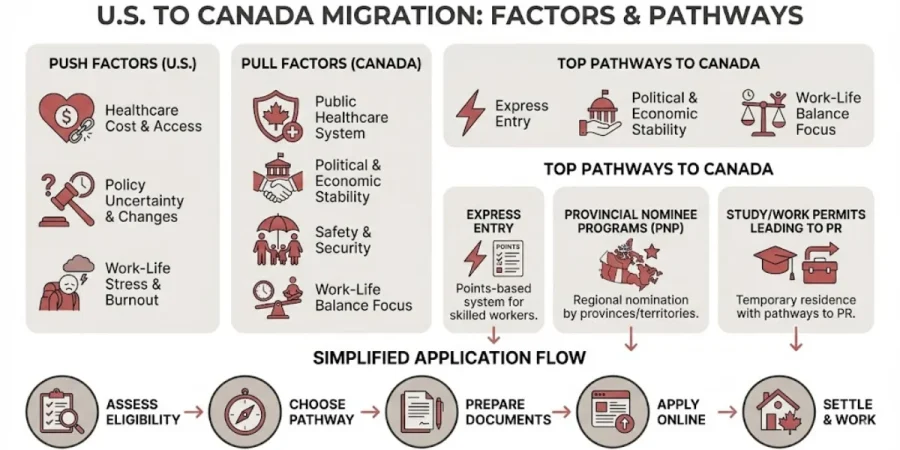
The growing interest in migration from the U.S. to Canada is shaped by a mix of push and pull factors. Rising healthcare costs, policy uncertainty, and work-life balance concerns in the U.S. are pushing people to look elsewhere, while Canada’s stable immigration system, universal healthcare, and strong quality-of-life indicators continue to pull migrants north.
Push Factors in the U.S.
Several factors are motivating Americans to explore opportunities abroad:
- Rising healthcare costs and insurance uncertainty
- Political polarization and policy unpredictability
- Job market volatility in certain industries
For many, these concerns are not temporary, prompting serious consideration of relocation rather than short-term moves.
Pull Factors Toward Canada
Canada offers compelling alternatives:
- Publicly funded healthcare
- Strong labor protections and worker benefits
- Safer communities and high livability rankings
- Family-friendly immigration policies
These advantages consistently appear in discussions about migration from the U.S. to Canada, especially among families and mid-career professionals.
Economic and Career Opportunities in Canada

Canada’s economy continues to rely on immigration to address labor shortages, particularly as the population ages. Skilled workers in technology, healthcare, engineering, construction, and education are in high demand, making the US to Canada immigration 2026 especially attractive for qualified professionals.
Remote work has also changed the game. Many Americans can now live in Canada while working for global or U.S.-based employers, further strengthening bilateral migration trends. To better understand how recent policy adjustments could influence job prospects and labor market opportunities for newcomers, Immigration Cuts in Canada and Job Market Impact breaks down the changes and offers insights into how applicants can plan more strategically in 2026 and beyond. This flexibility allows migrants to enjoy the Canadian quality of life without sacrificing career growth.
Entrepreneurs and investors also benefit from Canada’s start-up visa and business immigration programs, which offer a stable regulatory environment and a clear path to permanent residence.
Education and Family Pathways
Canada’s education system plays a major role in migration from the U.S. to Canada. American students are increasingly enrolling in Canadian universities due to:
- Competitive tuition fees
- Globally recognized degrees
- Post-graduation work opportunities
Many students transition from study permits to permanent residence, making education a strategic entry point into the US to Canada immigration 2026.
Family reunification is another strong pull factor. Canada prioritizes keeping families together through spousal sponsorships, dependent visas, and open work permits, features that make relocation less disruptive and more sustainable.
Cost of Living and Financial Realities
While Canada offers many benefits, it’s important to understand the financial picture. Housing costs in cities like Toronto and Vancouver can be high, but other regions offer more affordable living options. Taxes may be higher than in some U.S. states, but these costs often offset healthcare and social benefits.
For those considering migration from the U.S. to Canada, long-term financial planning is essential. Many migrants find that the overall quality of life balances out initial cost concerns.
Cultural and Lifestyle Adjustments
Culturally, the transition from the U.S. to Canada is relatively smooth. Shared language, similar social norms, and close geographic ties reduce culture shock. However, newcomers should be prepared for:
- Colder climates in many regions
- Bilingual environments in certain provinces
- Differences in workplace culture and communication styles
These adjustments are minor compared to the long-term benefits often cited in discussions around bilateral migration trends.
Challenges to Be Aware Of
While opportunities are strong, migration is not without challenges:
- Credential recognition may require additional licensing
- Processing times can vary depending on the program
- Competition for popular immigration streams is increasing
Understanding these realities helps applicants prepare effectively for the US to Canada immigration 2026 and avoid unnecessary delays.
How to Start Your Move to Canada
A successful move begins with preparation:
- Assess eligibility under Canadian immigration programs
- Choose the right pathway based on skills and goals
- Gather documents early (education, work experience, language tests)
- Monitor timelines and policy updates
If you are uncertain which immigration pathway best aligns with your profile or require step-by-step clarity, a comprehensive guide prepared by experienced consultants can help streamline the process and minimize avoidable errors. Combined with official government tools, professional guidance can significantly improve preparation and overall success rates for migration from the U.S. to Canada.
How Canada Shaws Supports Migration From the U.S. to Canada
At Canada Shaws, we specialize in guiding individuals and families through the growing trend of migration from the U.S. to Canada with clarity and confidence. Our team provides personalized immigration strategies tailored to each client’s background, whether through Express Entry, Provincial Nominee Programs, or study-to-PR pathways.
With a strong focus on compliance, accuracy, and up-to-date immigration policies, we help clients understand their eligibility, prepare strong applications, and navigate each step of the process efficiently.
As the US to Canada immigration 2026 continues to evolve, Canada Shaws remains committed to delivering informed, reliable, and professional support aligned with Canada’s latest immigration framework.
Final Thoughts
The growing interest in migration from the U.S. to Canada reflects more than short-term trends; it signals a shift in how people evaluate stability, opportunity, and quality of life. With structured pathways, strong social systems, and clear immigration goals, Canada continues to stand out as a top destination.
As the US to Canada immigration 2026 approaches, staying informed and planning strategically will be key. Whether driven by career goals, family priorities, or long-term security, Canada remains central to evolving bilateral migration trends, and for many Americans, the future looks brighter north of the border.
For individuals seeking personalized guidance and the latest insights into Canadian immigration pathways, Canada Shaws Consulting offers professional support to help ensure a well-informed and confidently planned immigration journey.
FAQs
Many Americans are exploring migration to Canada due to factors like affordable healthcare, clearer immigration pathways, work-life balance, and economic opportunities, making US to Canada immigration 2026 an increasingly discussed option.
Common routes include the Express Entry system for skilled workers, Provincial Nominee Programs (PNPs), and study or work permits that can lead to permanent residence. Canada’s point-based system gives clarity and predictability compared to many U.S. visa categories.
Yes. Canada’s publicly funded healthcare system is often cited as a major pull factor compared to the U.S. private insurance system, making it an important consideration for families and retirees.
Job growth in sectors like technology, healthcare, and engineering, combined with demand for skilled workers, makes Canada attractive to U.S. professionals looking for stable employment and long-term settlement options.