Canada Study Permit Changes: Rules Every Student Should Know

Dreaming of studying in Canada? You’re not alone. For years, Canada has been one of the world’s top destinations for international students. However, recent Study Permit Changes have significantly reshaped how students can apply, qualify, and plan their education journey. Understanding these Study Permit Changes is now more important than ever if you want to avoid refusals or delays.
If you’re looking for clear answers about Study Permit Rules in Canada, eligibility updates, and work opportunities while studying, this guide covers everything you need to know. From major policy shifts to expert insights, we break down how recent Study Permit Changes will affect international students and how to prepare confidently.
Let’s explore the most important Study Permit Changes in Canada and what every student should know before applying.
Why Canada Is Changing Its Study Permit Rules
According to Immigration, Refugees and Citizenship Canada (IRCC), Canada has seen a sharp increase in international student numbers in recent years. While this growth boosted the economy and educational institutions, it also placed pressure on housing, healthcare, and public infrastructure.
As part of a broader International Student Policy Change, the Canadian government introduced new Study Permit Changes to better manage student intake and ensure long-term sustainability. These reforms aim to balance quality education with responsible immigration planning.
What Is a Study Permit Anyway?
Before diving deeper into recent Study Permit Changes, let’s clarify the basics.
A study permit allows you to study in Canada for more than six months at a Designated Learning Institution (DLI). It is not a visa, meaning you may still need a visitor visa or an eTA to enter Canada. Without a valid permit, you cannot legally study in Canada. With evolving Study Permit Rules in Canada, holding the correct permit is critical for compliance.
Big Changes to Study Permits in 2024 to 2026
Canada introduced wide-ranging Study Permit Changes between 2024 and 2026 to control international student intake and strengthen compliance. These changes directly affect eligibility, documentation, and processing timelines.
Study Permit Caps Are Here, and They Matter
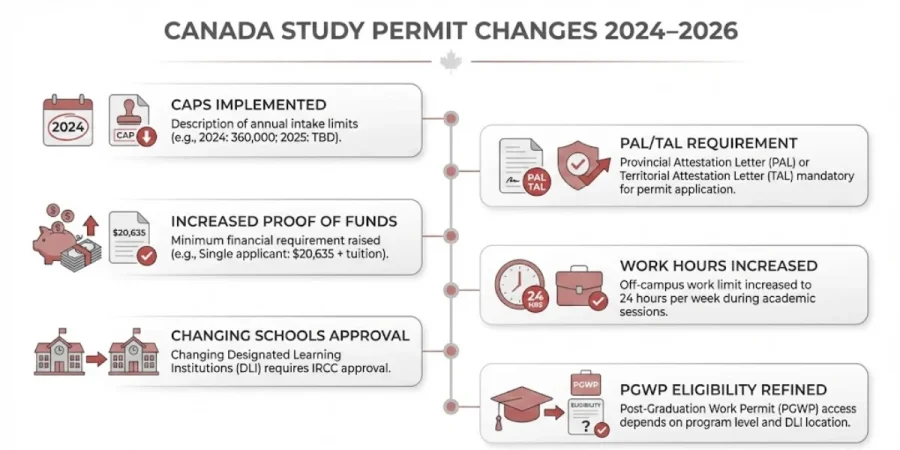
One of the biggest shifts is that Canada has introduced caps on the number of new study permits it will issue each year. This is historic, Canada never capped study permits before.
Here’s how the cap has evolved:
- 2024 The cap was set to allow around 360,000 new study permits. That’s a reduction of about 35% compared to 2023.
- In 2025, Canada plans to issue up to 437,000 study permits, about 10% less than in 2024.
These caps refer to permits issued, not the number of applications submitted. Once the cap or allocation for your province fills up, further applications might not be processed until the next cycle.
Renewals of current study permits, and students already inside Canada continuing at the same school and level, aren’t affected by these caps.
Attestation Letters (PAL/TAL)
To manage the cap, most international students now must include a Provincial or Territorial Attestation Letter (PAL/TAL) with their application. Think of it as a local confirmation that you’re counted within your province’s allocation under the cap.
Who typically needs a PAL/TAL?
- Most undergraduate, diploma, and language students
- Master’s and doctoral students in 2025 (this requirement expanded)
Who doesn’t need it?
- Primary or secondary (K‑12) students
- Renewals or extensions at the same DLI and study level
- Certain priority or exempt groups
Other Study Permit Rules You Should Know
Beyond the headline Study Permit Changes, several compliance-related rules affect international students throughout their stay.
a. Proof of Funds Requirements Increased
Updated IRCC guidelines now require stronger financial documentation. This Study Permit Proof of Funds 2025–26 ensures students can afford tuition, living expenses, and travel costs. It marks one of the most notable eligibility updates in recent years and aims to reduce financial hardship among students.
b. Working While Studying
According to the IRCC study permit rules, eligible international students may work up to 24 hours per week off-campus during academic sessions. While this rule supports budgeting, not all students automatically qualify. Always review your permit conditions carefully under the current Study Permit Rules in Canada.
c. Changing Schools or Programs
Another major Study Permit Change affects students switching institutions. You must now apply for and receive approval for a new study permit before starting a new program. This rule reinforces accountability and tighter compliance under Canada’s evolving international student framework.
What About After Graduation? (PGWP)

Post-Graduation Work Permit (PGWP) eligibility has also evolved alongside broader Study Permit Changes. Field-of-study requirements and program eligibility now play a larger role. While some policies were adjusted or temporarily reversed, PGWP eligibility increasingly depends on what and where you study.
Always verify the latest eligibility updates through IRCC or your institution.
What These Changes Mean for You
Here’s the reality: the Canadian study permit landscape is more competitive and regulated than ever.
Plan. Apply early; caps mean spaces can fill up fast.
Prepare documents carefully. Missing a PAL or proof of funds can delay or derail your application.
Choose eligible programs. If a PGWP matters to you, make sure your course qualifies.
Stay updated. Rules evolve; what’s true today may change next year.
Canada Shaws Key Services for Study Permit Applicants
Canada Shaws offers expert support for international students navigating Canada’s evolving study permit rules. Our services include study permit application assistance, program and institution selection advice, and document preparation and review to ensure IRCC compliance. We provide personalized immigration strategies, including how to meet proof of funds and eligibility requirements, and can represent you through the application process. Canada Shaws also supports related pathways such as Post-Graduation Work Permits (PGWP) and long-term immigration planning.
Studying in Canada can be complex with the new permit rules, but with the right support, it’s manageable. Book a consultation with Canada Shaws to get expert advice and ensure your application stands out.”
Final Thoughts
Canada remains a world-class study destination, but recent Study Permit Changes have transformed the international student journey. From caps and attestation letters to stricter eligibility rules, these reforms represent the most significant International Student Policy Change in over a decade.
By understanding these Study Permit Changes early, you can plan smarter, avoid costly mistakes, and pursue your education goals with confidence. If you’re preparing to apply, expert guidance can make all the difference. Connect with professionals early and stay informed every step of the way.
FAQs
Most undergraduate, diploma, and language students applying for a new study permit need a PAL or TAL. Exemptions include K-12 students and some renewals.
No. Students who are renewing their permit at the same institution and level are generally not affected by the cap.
Yes. Eligible study permit holders can work up to 24 hours per week during academic sessions and full-time during breaks.
Starting in 2025, most graduate students also need a PAL/TAL to apply for new study permits, though exemptions exist for certain doctoral programs.