Immigration and Housing Canada: How Housing Trends Influence Policy

Immigration and housing are closely connected in Canada’s policy planning. As Canada welcomes international students, temporary workers, and permanent residents, housing demand continues to rise across major and smaller cities.
Many newcomers face challenges linked to the housing shortage, affordability pressures, and limited rental supply. These realities now influence Canada’s Immigration targets, student intake caps, and settlement planning.
Canada Shaws helps international students understand how housing trends affect immigration decisions and how to prepare better for settlement.
This blog explains policy shifts, data insights, and practical guidance students should know before arriving in Canada.
Immigration and Housing: Why Housing Trends Matter in Canada
Housing availability plays a major role in shaping immigration and housing decisions. Federal and provincial governments now assess housing supply before setting intake targets.
When housing demand grows faster than construction, affordability declines. This directly affects newcomers who rely heavily on rental housing during their first years.
Key reasons housing trends influence policy include:
- Rising housing demand in student-heavy cities
- Pressure on rental affordability
- Infrastructure strain in fast-growing regions
These factors push policymakers to align immigration levels with real settlement capacity.
Housing Shortage and Canada Immigration Planning
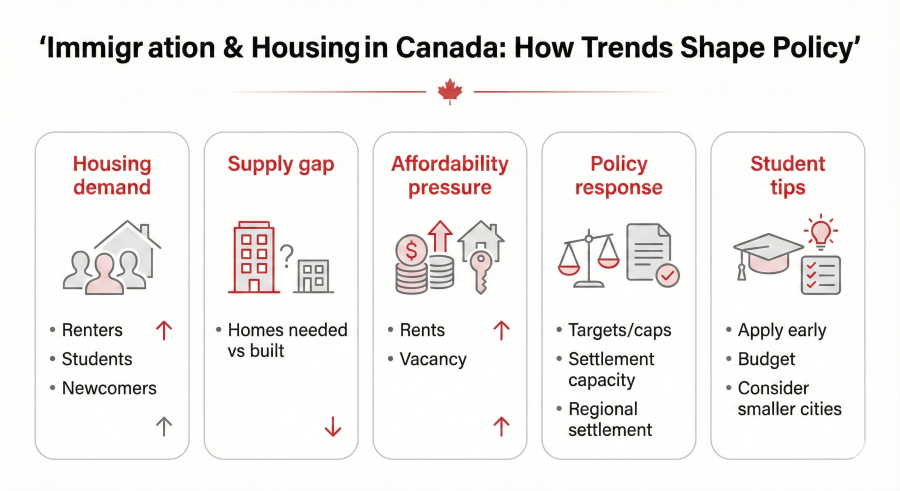
Canada’s housing shortage is increasingly shaping immigration planning, with policymakers aligning PR and temporary resident targets to available housing supply. This approach aims to ease pressure on rental markets while supporting sustainable population growth.
Housing shortage impacts on Canada’s Immigration
Our research highlights how the ongoing housing shortage is shaping Canada’s immigration planning. Cities like Toronto and Vancouver face limited rental availability, raising concerns about sustainable population growth. Explore the IRCC official website to understand the strategies and solutions being implemented to address these challenges.
To address this, Canada has adjusted PR and temporary resident intake to better match housing supply. These measures aim to protect both newcomers and local residents from extreme affordability pressures.
Recent planning focuses on:
- Balancing PR/temporary levels and housing availability
- Encouraging settlement in smaller communities
- Supporting purpose-built rental housing
Canada Shaws advises students to research regional housing markets before choosing institutions.
CMHC Housing Gap Immigration Analysis
The CMHC housing gap analysis underscores that recent immigration-driven population growth has significantly outpaced the development of new housing. These insights are now shaping federal and provincial strategies to align immigration levels with housing supply capacity. Policymakers are using this data to implement targeted measures aimed at mitigating shortages, promoting sustainable urban growth, and ensuring communities can accommodate both current and future residents effectively.
Understanding the CMHC housing gap: Immigration challenge
The Canada Mortgage and Housing Corporation estimates a large supply gap between required and available homes. This CMHC housing gap Immigration analysis is now used to guide federal decisions.
According to CMHC, Canada needs millions of additional homes by 2030 to restore affordability. Immigration inflows directly affect this calculation.
Policy responses include:
- Coordinating immigration targets with construction timelines
- Funding faster housing development
- Adjusting intake when supply lags behind demand
This data-driven approach reflects stronger links between immigration and housing planning.
StatsCan Immigrant Housing Use and Settlement Capacity

Statistics Canada data show immigrants are more likely to rent and live in larger households during initial settlement. These patterns help governments assess settlement capacity and plan housing, transit, and community services more effectively.
What StatsCan’s Immigrant housing use reveals
Data from Statistics Canada shows newcomers depend heavily on rental housing during initial settlement. StatsCan Immigrant housing use highlights higher occupancy rates among recent immigrants.
This impacts:
- Urban rental markets
- Student housing near colleges
- Municipal services and transit
Governments now evaluate Settlement Capacity before approving higher intake levels. Areas with better housing and services may receive more newcomers.
Canada Shaws supports students in choosing locations with healthier settlement capacity and housing options.
Housing Policy and Immigration at the Municipal Level
At the municipal level, housing policy and immigration intersect through zoning reforms, faster permitting, and infrastructure planning. Cities are adapting local policies to manage population growth while maintaining affordability and livability for residents.
Housing policy and immigration coordination
Municipal governments play a growing role in housing policy and immigration alignment. Cities report housing readiness to provincial and federal authorities.
Local impacts include:
- Zoning changes for higher-density housing
- Student accommodation planning
- Infrastructure expansion
These municipal impacts influence where newcomers are encouraged to settle. Smaller cities with available housing often receive policy support.
Understanding local housing policies helps students plan affordable living arrangements.
Practical Tips for International Students from Canada Shaws
Canada Shaws recommends proactive planning to manage housing challenges tied to immigration and housing trends.
Helpful tips include:
- Apply early for on-campus or student housing
- Budget realistically for rent and utilities
- Consider smaller cities with lower housing demand
- Understand regional affordability differences
These steps reduce settlement stress and support smoother transitions into Canadian life.
Common Mistakes to Avoid When Planning Housing
Many students underestimate housing challenges caused by the housing shortage.
Avoid these mistakes:
- Arriving without confirmed accommodation
- Ignoring local rental laws
- Choosing cities without checking vacancy rates
As Canada prepares for major shifts under the the staying informed is more important than ever. Canada Shaws supports students with verified housing insights and settlement preparation. Read our blog 2025 2027 Immigration Levels Plan: Big Changes for Canada to understand the changes and plan your move to Canada with confidence.
Conclusion
Understanding immigration and housing trends is now essential for international students. Housing supply directly influences Canada’s Immigration targets, study permit caps, and settlement policies.
With data from CMHC housing gap, Immigration reports, and StatsCan Immigrant housing use, Canada aligns intake with real-world capacity.
Canada Shaws supports students at every step from admission planning to settlement readiness, helping you make informed decisions despite housing challenges. To get personalised assistance, you are welcome to book your consultation with us today
FAQs
Housing supply directly impacts study permit caps and city selection. This affects where students can study affordably and how provinces manage international student intake.
Limited housing increases affordability risks, prompting Canada to align immigration intake with available housing and infrastructure capacity.
CMHC data highlights how many additional homes are required to restore housing affordability while managing population growth.
Canada Shaws assists with city selection, budgeting strategies, and settlement preparation to help newcomers plan housing effectively.