Canada New Entrepreneur Pilot 2026 Requirements Rumors: Is It Replacing the Start-Up Visa?

Canada has long been a top destination for global founders, and with immigration pathways evolving, entrepreneurs are once again paying close attention. With the Canada Start-Up Visa closed in 2026, many are now asking the same question: Is the New Entrepreneur Pilot the program that will replace it?
Although official details are still limited, early government signals and industry discussions strongly suggest that the New Entrepreneur Pilot will become Canada’s next major federal pathway for business immigration.
If you’re also looking for clear answers amid the uncertainty, this guide breaks down what’s confirmed, what’s still evolving, and what it could mean for your business plans. In this article, we’ll explore what led to this change, what the new pilot may look like, and how entrepreneurs can prepare.
What Happened to the Start-Up Visa Program?
The Start-Up Visa (SUV) Program officially stopped accepting new applicants after December 31, 2025, unless a valid commitment certificate was issued before that date. For founders who were mid-planning or exploring incubator options, this marked a significant shift in Canada’s business immigration landscape.
You can learn more about the changes and evolution of the program, including eligibility challenges and policy updates, are explained in Start-Up Visa Canada 2025: Your Complete Guide to Immigrate.
While applicants holding 2025 commitment certificates can still submit permanent residence applications until June 30, 2026, the program itself is effectively paused. This pause reflects broader immigration goals, reducing backlogs, improving program integrity, and focusing on economic outcomes rather than volume.
This policy gap is exactly where the New Entrepreneur Pilot enters the picture.
Why Canada Is Moving Toward a New Entrepreneur Pilot
The Canadian government has publicly acknowledged the need for a redesigned entrepreneur immigration stream. Rather than reopening the SUV in its previous form, IRCC Immigration Measures appears to be developing a New Entrepreneur Pilot that is more selective, outcome-driven, and aligned with Canada’s economic priorities.
Unlike the Start-Up Visa, which was heavily idea-focused, the new pilot is expected to emphasize execution, credibility, and long-term contribution. This shift reflects feedback from policymakers, designated organizations, and provinces that want stronger links between immigration approval and real business success.
Entrepreneurs hoping to understand how the New Entrepreneur Pilot might be structured can gain valuable insights by looking at the trends and competition under the Start-Up Visa, as highlighted in Start-Up Visa program insights
Designated Organizations: A More Controlled Role
Designated organizations played a central role under the Start-Up Visa, but not all endorsements resulted in viable businesses. Under the New Entrepreneur Pilot, these organizations are expected to remain part of the process, but with stricter oversight.
Future designated organizations may:
- Face annual endorsement limits
- Be assessed on founder success rates
- Be required to support fewer but stronger ventures
This change could significantly raise the overall quality of approved applications.
Commitment Certificate Transition and Its Impact
The Commitment Certificate Transition is one of the most critical elements for founders right now.
If you secured a commitment certificate before December 31, 2025, your application can still move forward under SUV rules. However, those who did not complete this step must now wait for the New Entrepreneur Pilot or pursue alternatives.
This transition period has created uncertainty, but it also highlights Canada’s intent to reset entrepreneur immigration with clearer standards and expectations.
A Stronger Emphasis on Founder Involvement

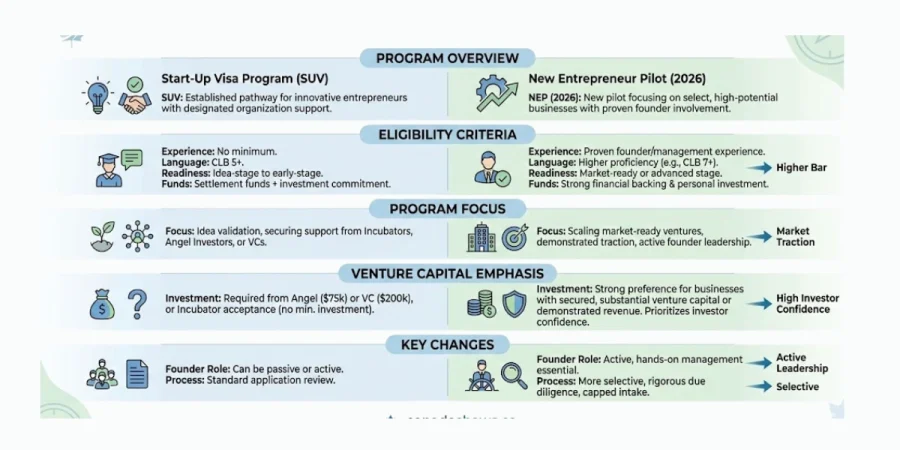
One of the most discussed changes expected under the New Entrepreneur Pilot is the stronger requirement for founder accountability. Immigration approval is likely to be tied not just to business plans, but to real involvement and performance.
This includes Active business management, meaning founders are expected to be directly involved in operating their companies in Canada, rather than acting as passive participants.
This approach aligns immigration success more closely with economic contribution.
Venture Capital Prioritization and Business Readiness
Another major shift being discussed is venture capital prioritization. While incubators played a dominant role under the SUV, the New Entrepreneur Pilot may place greater value on startups that already demonstrate market traction or investor confidence.
This does not mean early-stage founders are excluded, but it does suggest that Canada is favoring businesses with:
- Clear growth potential
- Revenue or validated demand
- Investment readiness
In essence, quality may matter more than quantity.
Expected Eligibility Under the Immigrant Entrepreneur Pilot 2026
While final rules are pending, most experts expect the Immigrant Entrepreneur Pilot 2026 to include:
- Founder experience and credibility
- Language proficiency
- Settlement funds
- Business viability and scalability
- Demonstrated economic benefit to Canada
Compared to the old system, the New Entrepreneur Pilot is expected to be more structured and transparent.
Alternatives to SUV Canada in the Meantime
Until the New Entrepreneur Pilot officially launches, entrepreneurs still have practical options:
- Provincial entrepreneur programs
- International Mobility Program (C-10)
- Express Entry or PNP pathways followed by business creation
Exploring alternatives to SUV Canada can help founders move forward without unnecessary delays.
Canada Shaws Services for the New Entrepreneur Pilot 2026
Planning to apply for Canada’s New Entrepreneur Pilot 2026 can be complex, especially with the Start-Up Visa now closed. Canada Shaws provides expert support to guide entrepreneurs through every step of the process.
Our services include:
- Assistance in assessing eligibility for the New Entrepreneur Pilot 2026
- Guidance on preparing and validating business plans for Canadian immigration
- Support in securing backing from designated organizations or investors
- Advice on active business management requirements in Canada
- Help with proof of funds, settlement planning, and compliance documentation
- Step-by-step guidance for transitioning from the Start-Up Visa framework to the new pilot
- Personalized strategies to maximize CRS points and improve immigration outcomes
Navigating Canada’s evolving entrepreneur immigration landscape can be challenging, especially with the introduction of new pathways like the New Entrepreneur Pilot. Canada Shaws offers expert guidance and end-to-end support for entrepreneurs planning their move to Canada, helping them stay compliant and competitive throughout the process Canada Shaws Consulting Inc.
Final Thoughts
While uncertainty remains, one thing is clear: Canada is not stepping away from entrepreneur immigration, it’s refining it. The New Entrepreneur Pilot appears designed to reward serious founders who are prepared to build, manage, and grow real businesses in Canada.
If you’re planning, now is the time to strengthen your business fundamentals, stay informed, and prepare for a more competitive, but potentially more rewarding, entrepreneur immigration landscape.
FAQs
While the Canadian government has not yet released full program details, IRCC has confirmed plans for a new entrepreneur-focused pilot in 2026. Based on current signals, the New Entrepreneur Pilot is expected to serve as the successor to the Start-Up Visa rather than reopening the SUV in its previous form.
You can only apply if you obtained a valid commitment certificate before December 31, 2025. Applicants without a prior certificate are no longer eligible and must wait for the New Entrepreneur Pilot or explore alternatives to SUV Canada.
The Immigrant Entrepreneur Pilot 2026 is expected to prioritize scalable, economically viable businesses with strong founder involvement, market traction, and potential investment interest, rather than idea-stage startups alone.
Yes. Entrepreneurs can consider provincial entrepreneur streams, the International Mobility Program (C-10 significant benefit), or qualifying through Express Entry or PNPs before launching a business in Canada.