Provincial Attestation Letter Canada (PAL) 2025–26: Validity Windows, Reuse Rules, and Who’s Exempt

Canada’s international student system changed significantly in 2025 with the introduction of the Provincial attestation letter requirement. Under the new study permit cap framework, most students must now include a valid PAL with their application. Understanding PAL validity 2025 is especially important, as incorrect timing or reuse can result in refusals.
At Canada Shaws Consulting, we guide international students through updated IRCC requirements, including PAL rules, DLI compliance, and province-specific processes.
This blog is designed for students planning to apply for a Canadian study permit in 2025-26 and explains how the Provincial attestation letter works, who needs it, and who is exempt.
You will learn about validity windows, PAL reuse rules, processing timelines, exemptions for graduate students, and how PAL differs from Quebec’s CAQ system.
What Is a Provincial Attestation Letter (PAL)?
The Provincial attestation letter is an official document issued by a Canadian province or territory. It confirms that an international student’s study permit application falls within that province’s allocated cap under IRCC’s study permit limits.
Key points students must understand:
- A PAL is mandatory for most new study permit applicants
- It must be issued before applying to IRCC
- It links your application to a specific DLI and program
The Provincial attestation letter helps provinces manage intake and ensures fair distribution of international students across Canada.
PAL Validity 2025, Validity Windows Explained
Understanding PAL validity 2025 is critical for the correct application timing. Each PAL has a limited validity window defined by IRCC and the issuing province.
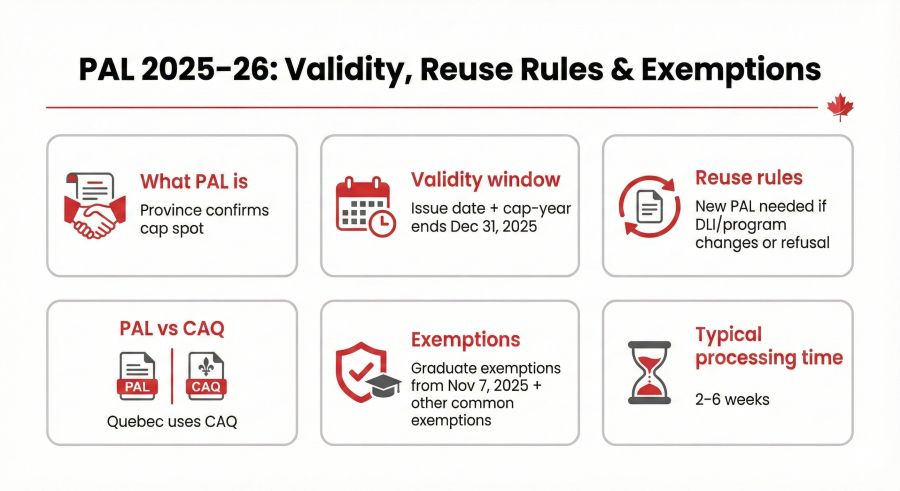
Cap Year 2025 Validity Through Dec 31, 2025
For the 2025 intake:
- Cap year 2025 validity through Dec 31, 2025, applies to most PALs
- A PAL cannot be used beyond the assigned cap year
- Applications submitted after expiry will be refused
Students must ensure their IRCC application is submitted while the PAL remains valid.
Issue Date Jan 22, 2025, and Its Impact
According to Official IRCC guidance on study permit and PAL requirements, Provincial Attestation Letters (PALs) issued on Jan 22, 2025 or later fall under the latest IRCC instructions for the 2025 study permit cap. Year PALs must be included with your study permit application if you’re subject to the cap, confirming your spot within your province’s allocation. These PALs are generally valid through Dec 31, 2025, and you cannot use a letter issued before Jan 22, 2025, for a 2025-cap application. Exemptions still apply for certain categories, like exchange students and in-Canada extensions, under specified conditions.
This means:
- Older offer letters alone are no longer sufficient
- Timing between admission and PAL issuance is crucial
- Canada Shaws helps students align timelines correctly
PAL Reuse Rules: Can You Use the Same PAL Twice?
One of the most common questions we receive concerns PAL reuse rules. In most cases, a PAL cannot be reused.
When PAL Reuse Is Not Allowed
You generally need a new PAL if:
- You change your DLI
- You switch programs
- Your previous application was refused
- Your PAL has expired
These PAL reuse rules are strictly enforced by IRCC.
Limited Situations Where Reuse May Apply
In rare cases, reuse may be considered if:
- The same DLI and program remain unchanged
- The original PAL is still valid
- The province explicitly permits reuse
Always confirm reuse eligibility before applying.
TAL Validity and TAL Terminology Explained
Some provinces issue a Territorial Attestation Letter, often referred to using TAL terminology.
TAL Validity
TAL validity follows similar rules to PALs:
- It is tied to the territorial study permit cap
- It must be valid at the time of IRCC submission
- Expired TALs are not accepted
Although terminology differs, IRCC treats PALs and TALs under the same legal framework.
How to Get PAL, Step-by-Step Guidance

Students often ask How to get PAL after receiving an offer letter. The process involves both the DLI and the province.
DLI Steps for PAL Issuance
The typical DLI steps include:
- Accepting your official letter of acceptance
- Confirming enrollment with the DLI
- DLI submits details to the province
- The province issues the PAL
Canada Shaws monitors each step to prevent delays or document mismatches.
PAL Processing Time
PAL processing time varies by province but usually ranges from 2 to 6 weeks. Delays can occur during peak intakes.
Planning ahead is essential to meet IRCC deadlines.
PAL vs CAQ, Understanding the Quebec CAQ Difference
Students planning to study in Quebec follow a different system. Understanding PAL vs CAQ avoids confusion.
Quebec CAQ Difference
Key points about the Quebec CAQ difference:
- Quebec does not issue PALs
- Students must apply for a CAQ (Certificat d’acceptation du Québec)
- CAQ serves a similar function but follows Quebec laws
IRCC accepts CAQs instead of PALs for Quebec institutions.
PAL Exemptions for Graduate Students
Not all students need a PAL. IRCC introduced exemptions to reduce administrative burden.
PAL Exemptions for Graduate Students
Under updated rules, PAL exemptions for graduate students apply in specific cases.
PAL Not Needed for Grad Students (From Nov 7, 2025)
According to IRCC updates, PAL not needed for grad students (from Nov 7, 2025) if they are enrolled in eligible master’s or doctoral programs.
This exemption:
- Applies to select graduate-level programs
- Does not apply to undergraduate students
- Still requires DLI and study permit compliance
Canada Shaws verifies exemption eligibility before application submission.
Common Mistakes Students Should Avoid
Students often face refusals due to avoidable errors.
Common issues include:
- Submitting an expired PAL
- Misunderstanding PAL validity 2025
- Ignoring PAL reuse rules
- Confusing PAL vs CAQ requirements
A professional review can significantly reduce these risks.
How Canada Shaws Supports International Students
At Canada Shaws Consulting, we offer end-to-end support for international students from study permit strategies under cap rules and PAL, TAL, and CAQ guidance to DLI compliance checks and refusal re-application support. For deeper insight, explore our Canada Study Permit Cap 2025: What Students Need to Know guide to better understand how the cap affects your application.
Conclusion
The Provincial attestation letter is now a core requirement for most Canadian study permit applicants. Understanding PAL validity 2025, PAL reuse rules, processing timelines, and exemptions can determine application success.
With changing rules such as PAL not needed for grad students (from Nov 7, 2025) and province-specific variations, expert guidance matters.
Canada Shaws Consulting helps students navigate every stage with clarity, accuracy, and compliance, ensuring smoother study permit outcomes.
You can also explore our consultation services for students and workers. Book a consultation with Canada Shaws today.
FAQs
A Provincial Attestation Letter confirms that your study permit application fits within a province’s allocated cap. It must be included with most study permit applications.
PAL validity in 2025 generally lasts until the end of the assigned cap year, often December 31, 2025, unless stated otherwise on the letter.
No. PAL exemptions for graduate students apply only to eligible programs and intake periods. Always confirm current requirements before applying.
No. Under PAL vs CAQ rules, students studying in Quebec must obtain a CAQ instead of a PAL.